 Add to Chrome
 Add to Firefox
 Add to Edge
Personalized Federated Learning by Energy-Efficient UAV Communications
May 24, 2026
Federated learning (FL) is an effective paradigm for enhancing the learning capability of edge devices while preserving data privacy. In geographically dispersed FL systems, such as sensor networks in remote areas, unmanned aerial vehicles (UAVs) can flexibly establish high-quality communication links to support parameter exchange. However, device heterogeneity and the limited battery capacity of UAVs pose significant challenges. Specifically, data heterogeneity slows convergence, while scheduling all devices for global collaboration incurs excessive communication and energy costs. To overcome these challenges, we adopt a strict separation between a globally shared backbone and permanently local personalization heads, thereby mitigating the impact of data heterogeneity. Furthermore, we propose a gradient-based scheduling strategy that jointly considers energy efficiency and learning performance. In each communication round, the backbone is updated only by the top-$α$ devices ranked by gradient $\ell_{2}$-norm, ensuring that optimization focuses on the most informative updates. Simulation results demonstrate that the proposed scheme achieves higher learning accuracy than state-of-the-art approaches while significantly reducing UAV energy consumption.

TCFormer: A 5M-Parameter Transformer with Density-Guided Aggregation for Weakly-Supervised Crowd Counting
Dec 21, 2025Crowd counting typically relies on labor-intensive point-level annotations and computationally intensive backbones, restricting its scalability and deployment in resource-constrained environments. To address these challenges, this paper proposes the TCFormer, a tiny, ultra-lightweight, weakly-supervised transformer-based crowd counting framework with only 5 million parameters that achieves competitive performance. Firstly, a powerful yet efficient vision transformer is adopted as the feature extractor, the global context-aware capabilities of which provides semantic meaningful crowd features with a minimal memory footprint. Secondly, to compensate for the lack of spatial supervision, we design a feature aggregation mechanism termed the Learnable Density-Weighted Averaging module. This module dynamically re-weights local tokens according to predicted density scores, enabling the network to adaptively modulate regional features based on their specific density characteristics without the need for additional annotations. Furthermore, this paper introduces a density-level classification loss, which discretizes crowd density into distinct grades, thereby regularizing the training process and enhancing the model's classification power across varying levels of crowd density. Therefore, although TCformer is trained under a weakly-supervised paradigm utilizing only image-level global counts, the joint optimization of count and density-level losses enables the framework to achieve high estimation accuracy. Extensive experiments on four benchmarks including ShanghaiTech A/B, UCF-QNRF, and NWPU datasets demonstrate that our approach strikes a superior trade-off between parameter efficiency and counting accuracy and can be a good solution for crowd counting tasks in edge devices.
A Two-stage Optimization Method for Wide-range Single-electron Quantum Magnetic Sensing
Jun 16, 2025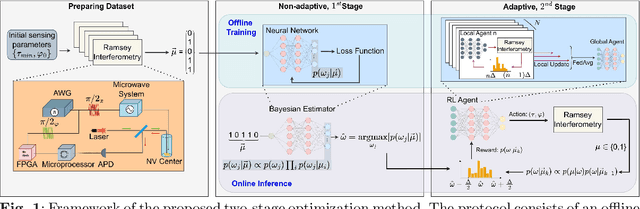
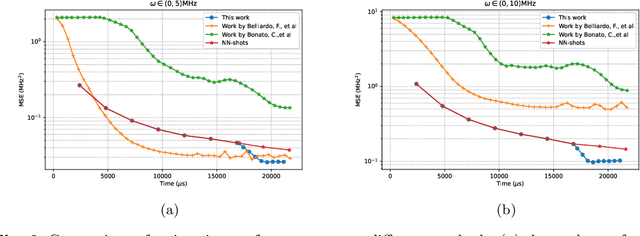
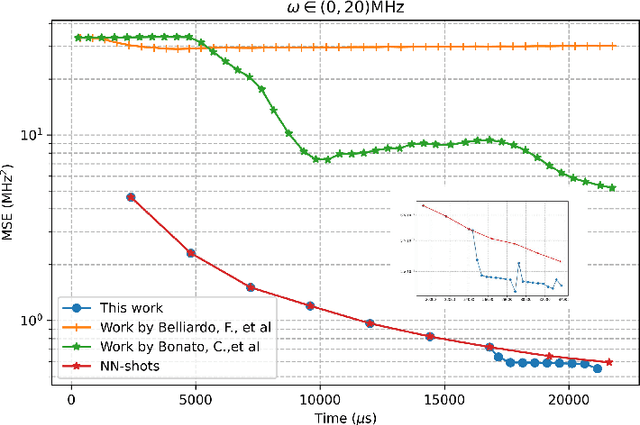
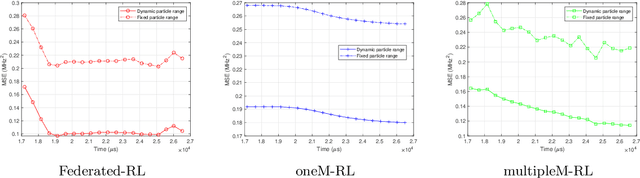
Quantum magnetic sensing based on spin systems has emerged as a new paradigm for detecting ultra-weak magnetic fields with unprecedented sensitivity, revitalizing applications in navigation, geo-localization, biology, and beyond. At the heart of quantum magnetic sensing, from the protocol perspective, lies the design of optimal sensing parameters to manifest and then estimate the underlying signals of interest (SoI). Existing studies on this front mainly rely on adaptive algorithms based on black-box AI models or formula-driven principled searches. However, when the SoI spans a wide range and the quantum sensor has physical constraints, these methods may fail to converge efficiently or optimally, resulting in prolonged interrogation times and reduced sensing accuracy. In this work, we report the design of a new protocol using a two-stage optimization method. In the 1st Stage, a Bayesian neural network with a fixed set of sensing parameters is used to narrow the range of SoI. In the 2nd Stage, a federated reinforcement learning agent is designed to fine-tune the sensing parameters within a reduced search space. The proposed protocol is developed and evaluated in a challenging context of single-shot readout of an NV-center electron spin under a constrained total sensing time budget; and yet it achieves significant improvements in both accuracy and resource efficiency for wide-range D.C. magnetic field estimation compared to the state of the art.